
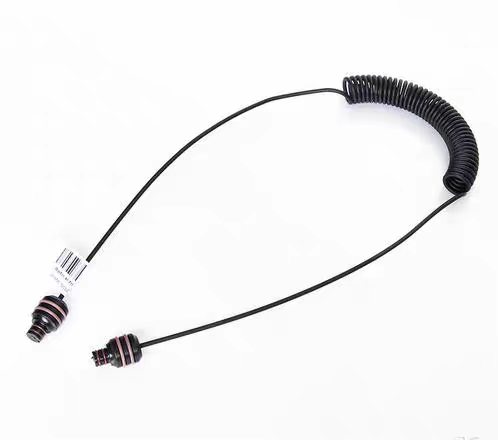
In underwater photography, plastic optical fiber (POF) trigger cables are the mainstream solution for connecting cameras to external strobes. Their core advantages lie in their water resistance, reliability, and universal compatibility.
## 1. How It Works: Transmitting Flash Signals via Light
The core principle is elegant and straightforward:
- The Signal: When the shutter is pressed, the camera’s built-in flash (or a hot-shoe LED trigger inside the housing) emits a light signal.
- Total Internal Reflection: One end of the optical fiber receives this light. Utilizing the principle of Total Internal Reflection—where the highly transparent PMMA core is surrounded by a cladding with a lower refractive index—the light is repeatedly reflected and transmitted internally to the other end with minimal loss.
- Synchronization: Upon receiving the light pulse, the light-sensitive slave sensor on the external strobe triggers the flash instantly, achieving precise synchronization with the camera’s shutter.
## 2. Why “Plastic” Instead of Glass?
Underwater environments place extreme demands on the flexibility and durability of gear. Plastic optical fiber (made of PMMA) perfectly meets these challenges:
- High Flexibility: It can be tightly coiled into a spring shape, stretching over 1 meter without losing its shape or breaking, allowing photographers to reposition strobe arms freely.
- Cost-Effective & Durable: PMMA is highly resistant to moisture and salt. Unlike glass fibers, it will not suffer from stress fractures or micro-cracks over prolonged underwater use, and it is inexpensive to replace if accidentally damaged.
- High Transmission Efficiency: It offers excellent transmission for visible light, ensuring the sync signal reaches the strobe reliably without noticeable attenuation.
## 3. The Gold Standard: Multi-Core Cables (613-Fiber)
Professional underwater fiber optic cables are almost exclusively multi-core (fiber bundles); single-core cables are rarely used today. Even when bent at sharp angles, a multi-core cable ensures that a vast majority of its micro-fibers continue to transmit light normally, preventing misfires.
- The Industry Standard: 613-core cables are the standard equipment across premium brands like Sea&Sea, INON, Nauticam, and Backscatter.
- Specifications: Made of premium PMMA, these cables feature a core diameter of approximately 1.5mm, offering a perfect balance of low attenuation and high pliability.
- The Benefit: They deliver uniform light transmission at all angles, ensuring stable performance from shallow reefs to the deep ocean, and boast strong resistance to ambient sunlight interference.