
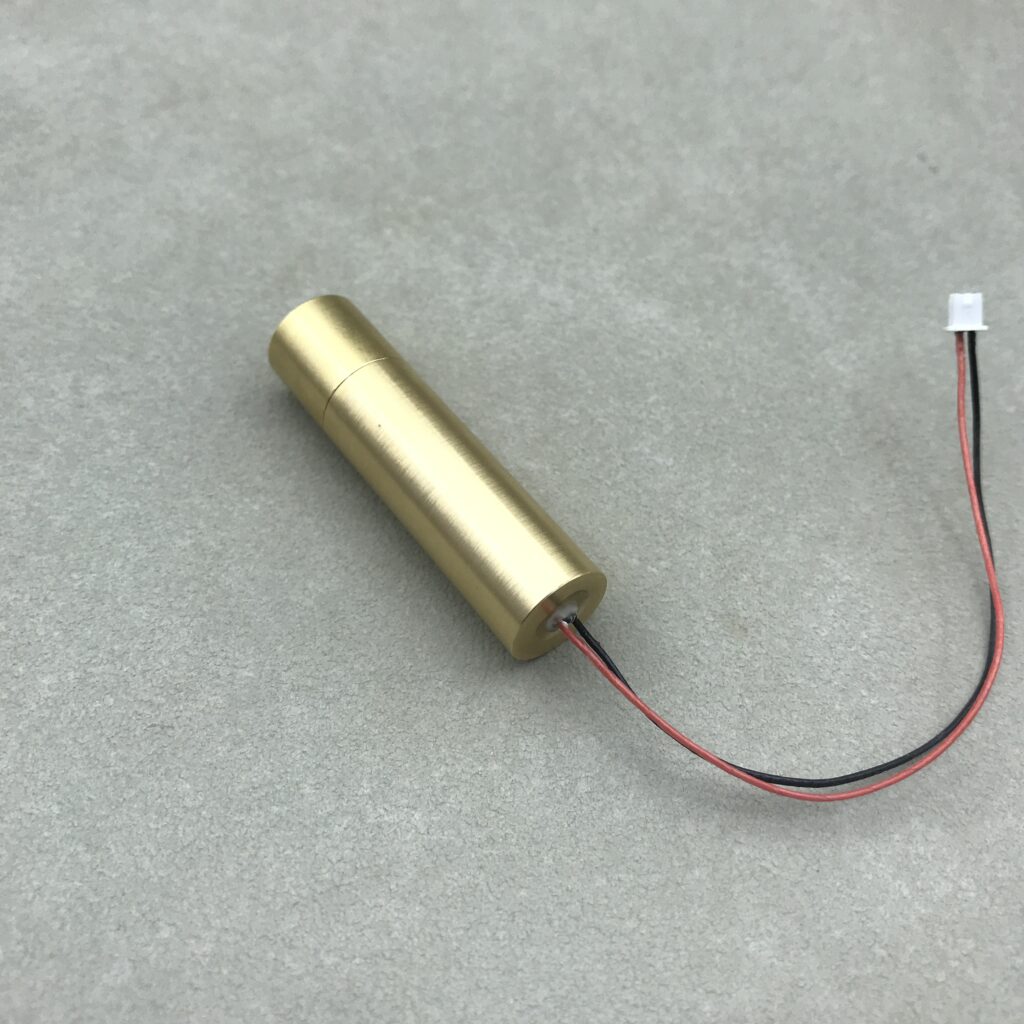
650nm red dot laser modules are commonly used for industrial alignment, machine vision, positioning, sensing, and scientific equipment. In actual field applications, however, choosing between a 5mW and a 50mW module is not simply a matter of choosing the “brighter” option.
The key question is: How much optical power does the application actually need?
From practical use, the difference becomes obvious when you consider ambient light, projection distance, thermal management, and laser safety.
1. When 5mW Is Enough
For indoor alignment and short-distance positioning, 5mW is often the more practical choice.
A typical 5mW module operates at around 30mA and is commonly classified as Class 3R. Because the optical output is relatively low, thermal stress is also limited, making a 5V power supply relatively straightforward to implement.
In the field, the main advantages are easy to notice:
- Low heat generation
- Long operating life
- Simple 5V drive requirements
- Lower overall safety risk compared with higher-power modules
- Good visibility for indoor alignment and positioning
The main limitation appears when ambient light increases. Under strong factory lighting or semi-outdoor conditions, the red dot can become difficult to see, especially at longer distances.
Practical rule: if you are mainly aligning components indoors, positioning equipment, or pointing at a nearby target, start with 5mW rather than automatically moving to a higher-power module.
2. When 50mW Makes a Real Difference
The situation changes considerably when the laser has to remain visible over a longer distance or compete with strong ambient light.
A 50mW module can deliver roughly ten times the optical output of a 5mW module. Typical operating current can reach around 80mA, providing substantially higher dot brightness.
This makes 50mW useful in applications such as:
- Industrial positioning on brightly illuminated factory floors
- Semi-outdoor alignment where ambient light is difficult to control
- Auxiliary illumination for machine-vision image acquisition
- Long-distance photoelectric sensing or triggering
- Long-range aiming and indication
- Certain biomedical or analytical instruments requiring higher optical output
In these situations, the extra optical power is not simply about making the dot look brighter. It can provide enough power density at the target to make the optical signal reliably detectable.
3. The Trade-Off: More Power Means More Heat
This is one of the most important things I would check during actual installation.
A 50mW module generates noticeably more heat than a 5mW module. If the heat cannot escape efficiently, the laser diode can experience temperature-related wavelength drift, reduced optical output, and a shorter operating lifetime.
For continuous operation, I would therefore pay attention to the mechanical installation rather than treating the laser module as a simple plug-and-play component.
A brass or aluminum housing can provide a useful heat path and improve heat dissipation. The module should also have sufficient contact with the surrounding mechanical structure when the application requires long operating periods.
In other words:
If you need 50mW, plan the thermal path at the same time you plan the optical path.
4. Don’t Forget Laser Safety
There is also a major safety difference between the two power levels.
A 50mW visible laser module falls within Class 3B laser safety requirements. Direct eye exposure is hazardous, and specular reflections can also present a serious risk.
When working with a 50mW module, appropriate laser safety controls are therefore essential, including protective eyewear rated for the 650nm wavelength, controlled beam paths, and suitable procedures to prevent accidental exposure.
The fact that the laser is only a small module does not make the optical output harmless.
5. A Simple Field Selection Method
When selecting a module for a new project, I would work through the following questions:
Is the application indoors?
If yes, 5mW is often sufficient.
Is the ambient light strong?
If the dot becomes difficult to identify, consider moving toward 50mW.
Is the projection distance long?
Higher optical power may provide a more reliable visible or detectable signal.
Does the laser run continuously?
If using 50mW, thermal management becomes a design requirement rather than an optional improvement.
Is the beam accessible to operators?
If yes, laser classification and safety controls should be considered before increasing optical power.
6. 5V Input Does Not Mean Identical Drivers
Both 5mW and 50mW modules can be used with a standard DC 5V external power supply, provided the adapter can supply more than 100mA.
However, the two modules should not be treated as electrically identical just because they use the same nominal input voltage.
Their internal constant-current driver designs can be significantly different. Custom driver components or configurations designed for one power level should not simply be transferred to the other.
Before modifying or replacing a driver, check the module’s actual operating current and internal driver requirements.
Conclusion: Choose for the Application, Not the Power Rating
From a practical field perspective, the choice is fairly straightforward:
Choose 5mW for indoor alignment, short-range positioning, and applications where lower heat and simpler safety management are priorities.
Choose 50mW when strong ambient light, longer projection distances, machine-vision assistance, or higher optical power density make 5mW insufficient.
The important point is that 50mW is not automatically a better version of 5mW. It is a different tool for a different operating environment—and once you move to higher optical power, thermal management and laser safety become part of the system design.