
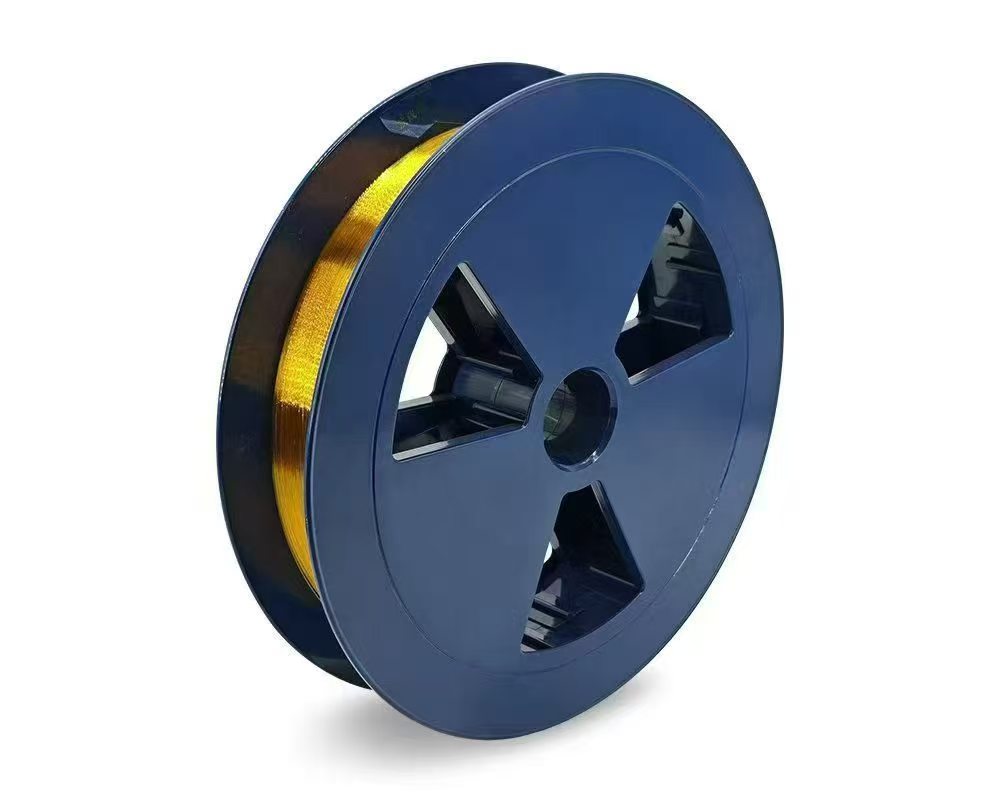
When building a Fiber Bragg Grating (FBG) sensor array for aerospace applications, choosing the right specialty optical fiber is critical to the long-term reliability of the sensing system.
For harsh aerospace environments, fiber coating, mechanical strength, geometry, and temperature performance should all be carefully considered.
1. Choose Polyimide (PI) Coating for High-Temperature Applications
For high-temperature aerospace applications, polyimide (PI) coating is often preferred over standard acrylate-coated communication fiber.
Standard acrylate coatings are generally designed for conventional telecom environments and may degrade at elevated temperatures. PI-coated fibers provide significantly better high-temperature resistance, with some specialty fibers rated for continuous operation at around 300°C or higher, depending on the fiber and coating design.
This makes PI-coated fibers a suitable choice for applications involving high temperatures and repeated thermal cycling.
2. 1550 nm Single-Mode Fiber Is a Common Choice
1550 nm single-mode fiber is widely used for FBG sensing and is a common choice for multi-point sensor arrays.
The low optical loss of single-mode fiber at the 1550 nm wavelength helps maintain stable signal transmission over long fiber links and supports multiplexed FBG sensor arrays.
The exact operating wavelength, however, should be selected according to the FBG design, interrogator, and system requirements.
3. Mechanical Strength and Fatigue Resistance Matter
Aerospace sensor arrays can be exposed to vibration, thermal cycling, and mechanical stress over long service periods.
Therefore, the optical fiber should have an appropriate proof-test level and good resistance to mechanical fatigue. A proof-test level of 100 kpsi or higher is commonly specified for some specialty fiber applications, but the appropriate value depends on the mission requirements and installation conditions.
Fiber selection should consider not only the proof-test strength, but also bending radius, coating performance, installation stress, and long-term fatigue behavior.
4. Tight Geometrical Tolerances Improve Manufacturing Consistency
Key fiber geometry parameters, such as cladding diameter and core-cladding concentricity, should be well controlled.
Consistent fiber geometry helps improve manufacturing consistency, connectorization, splicing, and the repeatability of FBG fabrication. However, FBG writing quality also depends on factors such as the fiber’s refractive-index profile, photosensitivity, and grating fabrication process.
For large sensor arrays, good fiber-to-fiber consistency can help achieve more uniform sensor performance across multiple sensing points.
Conclusion
For aerospace FBG sensor arrays, fiber selection should go beyond optical specifications alone.
Polyimide-coated specialty single-mode fiber can be a strong choice for demanding environments where high-temperature resistance, mechanical reliability, and long-term stability are important.
Standard telecom fiber may be suitable for some aerospace FBG applications, but it should not be assumed to meet the requirements of harsh or long-life aerospace environments without proper qualification.
The key factors to consider include:
- Coating: Polyimide (PI) for high-temperature applications
- Wavelength: 1550 nm single-mode fiber is a common FBG choice
- Mechanical performance: Appropriate proof-test strength and fatigue resistance
- Geometry: Tight and consistent fiber dimensions
- System compatibility: FBG fabrication process, interrogator, installation, and environmental requirements
We provide custom-length PI-coated specialty single-mode fiber for FBG sensing applications, with sample testing .