
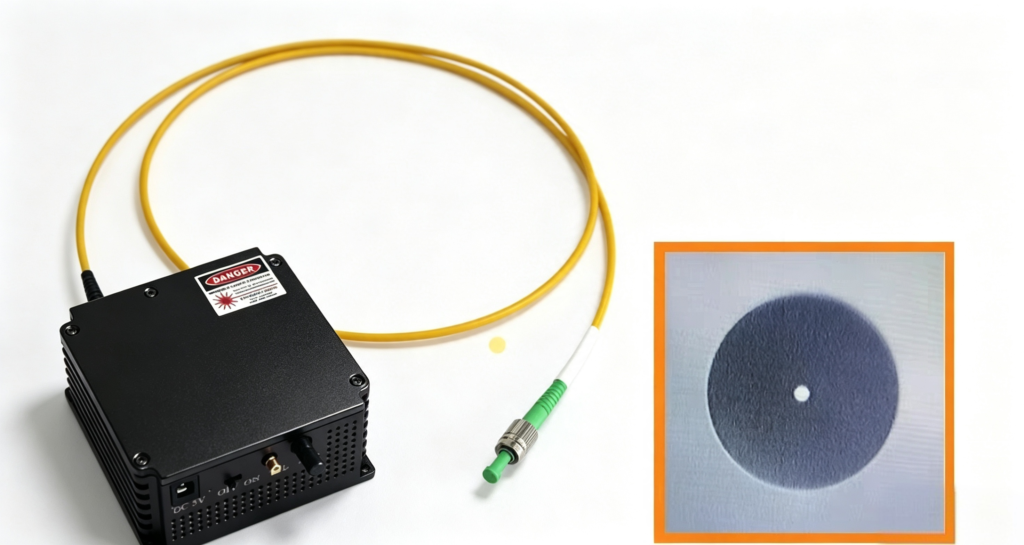
When choosing a 520 nm green fiber-coupled laser module, it is important to understand the differences between single-mode and multimode fiber options. Each offers distinct advantages for different laboratory applications, and the right choice depends on your experimental requirements.
1. Single-Mode Fiber-Coupled Laser Module
Key specifications
- Fiber core diameter: 3.5 μm
- Numerical aperture (NA): 0.13
- Available output power: 30 mW / 50 mW
The single-mode version supports a near-Gaussian output beam profile, making it suitable for applications that require good spatial beam quality and precise optical alignment.
Typical applications
- Optical interferometry and holography
- Precision spectroscopy
- Microscopic focusing
- Fiber-optic sensing
Note: Single-mode fiber coupling requires more precise alignment. The maximum available output power for this version is 50 mW.
2. Multimode Fiber-Coupled Laser Module
Key specifications
- Fiber core diameter: 105 μm
- Numerical aperture (NA): 0.22
- Available output power: 50 mW / 100 mW
The multimode version offers a larger fiber core and greater coupling tolerance, making optical alignment and integration more convenient in many applications. It also provides a 100 mW output power option.
Typical applications
- Fluorescence excitation
- Sample illumination
- Silicon wafer inspection
- Liquid sample analysis
- Optical education and laboratory experiments
Note: Multimode output profiles may vary with fiber mode distribution and coupling conditions. Modal interference and speckle may affect applications that require a stable spatial intensity distribution or precise interferometric performance.
3. Quick Selection Guide
- Need a near-Gaussian beam profile and good spatial beam quality? Choose the single-mode version.
- Need an output power of 100 mW? Choose the multimode version.
- Need easier fiber coupling and alignment? Consider the multimode version.
- Planning precision interferometry or holography? Evaluate the spatial mode, spectral linewidth, coherence length, and stability requirements before selecting a model.
4. Compact Design and Integration
The compact laser module measures 70 × 60 × 32 mm and operates on a 12 V DC power supply.
Additional specifications include:
- TTL modulation frequency: 1 Hz–30 kHz
- Spectral bandwidth: 1.5–2.5 nm
- Fiber pigtail length: 0.9–1 m
- Available fiber connectors: FC/PC, FC/APC, SMA905, ST, and SC, depending on the model
These features make the modules suitable for integration into a wide range of laboratory optical systems and experimental setups.