
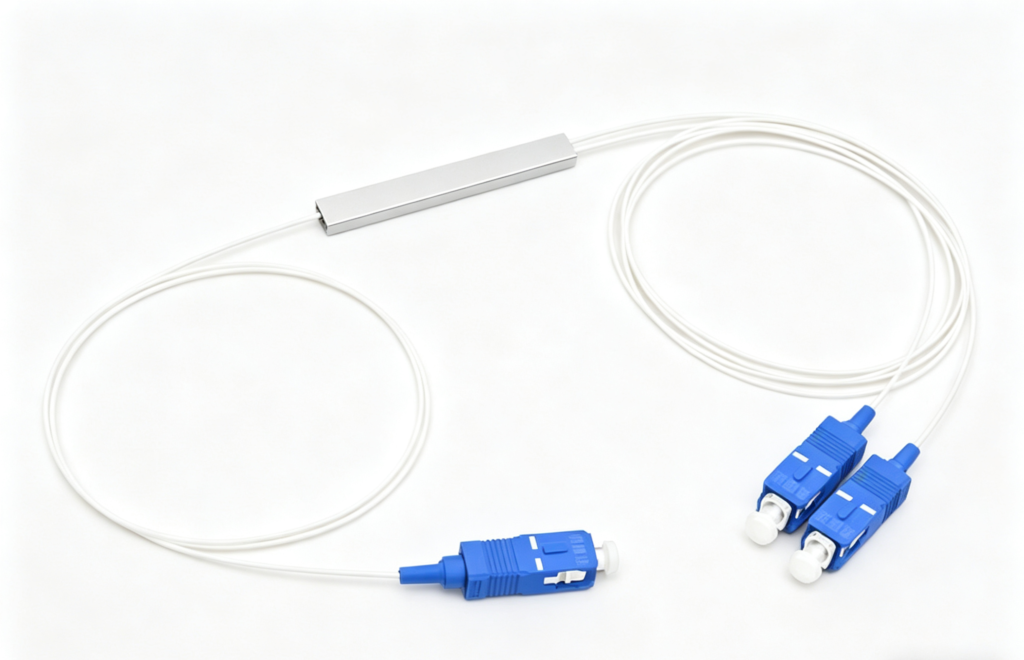
A PM FBT Coupler (Polarization-Maintaining Fused Biconical Taper Coupler) is used to split or combine polarized optical signals while maintaining polarization performance. It is widely used in fiber lasers, optical amplifiers, optical instruments, and fiber-optic sensing systems.
Here are the key specifications to consider when selecting a PM FBT coupler.
1. Choose 1×3 or 3×3
- 1×3 PM FBT Coupler: 1 input and 3 outputs, mainly used for optical power splitting and distribution. A common configuration is 33/33/33 equal splitting.
- 3×3 PM FBT Coupler: 3 inputs and 3 outputs, commonly used in interferometric and fiber-optic sensing systems with multiple optical paths.
If you only need to split one optical signal into three outputs, a 1×3 coupler is usually the right choice.
2. Match the Wavelength
Choose the coupler according to the operating wavelength of your laser or optical source.
Common options include 850 nm, 1064 nm, 1310 nm, and 1550 nm.
For example, if your laser operates at 850 nm, select an 850 nm PM FBT Coupler.
FBT couplers are wavelength-dependent, so always check the specified operating wavelength and bandwidth with the manufacturer.
3. Select the Split Ratio
For a 1×3 coupler, 33/33/33 is a common equal-split configuration.
Custom ratios such as 40/20/40, 35/30/35, 20/60/20, and 10/80/10 may also be available.
When choosing a split ratio, check both the nominal ratio and its tolerance to make sure it meets your system requirements.
4. Check Optical Performance
For PM applications, pay attention to:
- Extinction Ratio (ER): Indicates how well the coupler maintains the required polarization state.
- Insertion / Excess Loss: Check the manufacturer’s test definition when comparing products.
- Return Loss: Important for laser and other reflection-sensitive systems.
- Power Handling: Select according to the actual optical power and operating conditions.
For high-power applications, confirm the power rating with the manufacturer before ordering.
5. Select the PM Fiber
The fiber type should match your wavelength and system requirements.
Typical PM fiber options include PM-850, PM460-HP, and PM1550.
For an 850 nm application, PM-850 or another suitable 850 nm PM fiber may be selected depending on the system design.
If polarization performance is important, also specify the required fast-axis or slow-axis alignment.
6. Choose the Connector
Common connector options include:
- FC/PC – widely used in laboratories and optical test systems
- FC/APC – suitable when lower back reflection is required
- LC – compact and suitable for high-density applications
- SC – push-pull design for general fiber-optic equipment
- ST – bayonet-style connector, often used in legacy systems
Pigtail length can also be customized according to the installation requirements.
Quick Selection Checklist
Before ordering a PM FBT coupler, confirm:
- Configuration: 1×3 or 3×3
- Wavelength: e.g. 850 nm
- Split ratio: e.g. 33/33/33
- PM fiber: e.g. PM-850
- Extinction ratio and optical loss
- Maximum optical power
- Axis alignment: Fast axis or Slow axis
- Connector: LC / FC / SC / ST / FC/APC
- Pigtail length
- Operating temperature and package
Example
For an 850 nm fiber-optic sensing application, a typical requirement could be:
850 nm / 1×3 / 33:33:33 / PM-850 / FC/APC / 1 m pigtails
With these basic specifications, a manufacturer can quickly recommend the appropriate PM FBT coupler for your application.