
In Part 1 of this technical deep dive, we explored the physical constraints of Optical Circuit Switches (OCS) and why multi-mode fiber (MMF) causes unacceptable insertion loss (5-10dB).
As established, single-mode fiber (SMF) is non-negotiable for OCS. But how are these micron-scale single-mode fibers physically arranged, aligned, and integrated into high-density OCS hardware?
In Part 2, we examine the workhorse component of OCS input/output ports: the 2D Collimating Fiber Array Unit (2D FAU), and break down the exact fiber calculations for commercial OCS deployments.
1. The Interface Workhorse: 2D Fiber Array Units (2D FAU)
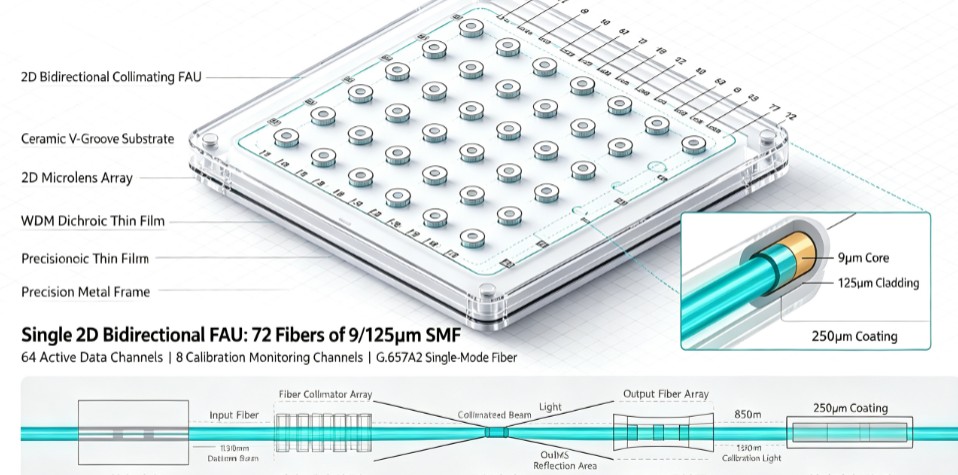
The standard interface component in an OCS is the 2D Collimating Fiber Array Unit (2D FAU). Far more than a passive mounting bracket for holding fibers, it functions as the high-precision optical receiving and transmitting port for the entire free-space beam processing engine.
- Role Separation: The 2D MEMS mirror array handles beam steering exclusively.
- Coupling Efficiency: Whether light can enter, exit, propagate, and maintain bi-directional reciprocity depends entirely on the mechanical stability and polished quality of the 2D FAU.
- Fiber Construction: High-precision silica fibers (standard core/cladding diameter of $9/125\,\mu\text{m}$) are ribbonized, stripped of outer coatings, fixed inside micro-grooved glass substrates with tight pitch tolerances, and precision-polished.
- Fiber Standard: The industry standard choice is G.657.A2 bend-insensitive single-mode fiber (BI-SMF).
2. Fiber Count Breakdown in Commercial OCS Architectures
A functional MEMS OCS machine relies on two matching 2D FAUs (an Input FAU and an Output FAU). To maintain dynamic beam steering calibration, real-time feedback loops, and automated mirror alignment, these FAUs combine operational business channels with redundant calibration fibers:
| OCS Configuration | Active Business Fibers | Redundant / Calibration Fibers | Fibers per FAU | Total System Fibers (2 FAUs) |
| 32×32 OCS (Entry / Small Port) | 32 channels | 6 channels | 38 fibers | 76 fibers |
| 64×64 OCS (Mainstream AI Compute Cluster) | 64 channels | 8 channels | 72 fibers | 144 fibers |
3. Final Engineering Takeaway
While MEMS micro-mirrors serve as the dynamic “steering wheel” of an Optical Circuit Switch, single-mode fiber arrays—crafted with G.657.A2 optical fiber—provide the essential high-bandwidth “smooth highway.”
Mastering sub-micron 2D FAU alignment and understanding the physical trade-offs of single-mode beam propagation are what elevate OCS technology from a theoretical laboratory concept into the backbone of modern AI infrastructure.