
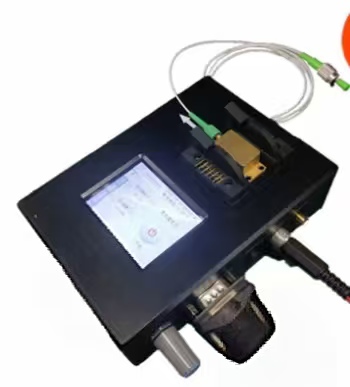
The seamless collaboration between semiconductor laser display drivers and fiber optic systems is built on a closed-loop ecosystem: “Precise laser output control via drivers → Efficient optical signal transmission through fibers → Real-time system feedback optimization.”
At its core, this synergy ensures light signals move from generation to transmission in a stable, controllable, and high-performance manner. Let’s break down the key components, their working principles, and real-world applications.
Key Components & Their Roles
1. Semiconductor Laser Display Drivers: The “Brain & Controller”
More than just power sources, these integrated devices combine drive control and visual monitoring to stabilize laser operation. Their core mission? Deliver consistent current and temperature regulation while enabling user-friendly interaction.
Core Capabilities & Advantages:
- All-in-One Design: Integrates a high-precision current source and temperature controller for end-to-end laser management.
- Non-PWM Temperature Control: Uses continuous current output to regulate TEC (Thermoelectric Cooler) components, extending their lifespan and reducing thermal fluctuations.
- Multi-Layer Protection: Features adjustable current clamping and soft-clamping functions to prevent laser tube damage from high-current misoperations or voltage spikes.
- Visual Interaction: Built-in displays show real-time parameters (current, temperature, optical power) and support dynamic adjustments—critical for on-the-fly optimization.
2. Fiber Optic Cables: The “Low-Loss Conduit”
Fibers act as the physical bridge for laser signals, leveraging optical principles to transmit light with minimal loss or distortion. Their performance hinges on two key factors: design matching and transmission efficiency.
How Fibers Work: Total Internal Reflection
Fibers consist of a high-refractive-index core (e.g., germanium-doped silica) and a low-refractive-index cladding. When laser light enters the core at an angle greater than the critical angle, it undergoes continuous total internal reflection at the core-cladding interface—enabling long-distance transmission (single-mode fibers achieve losses as low as 0.2 dB/km at 1550 nm).
Critical Design Considerations for Compatibility:
- Fiber Type Matching: Single-mode fibers (9μm core diameter) are optimized for pairing with narrow-linewidth lasers (e.g., DFB, DBR) in optical communications and precision measurement scenarios. Multimode fibers (50/62.5μm core diameter) work seamlessly with high-power broadband lasers, making them ideal for industrial processing and illumination applications.
- Interface Compatibility: Common connectors such as FC/APC, SC/APC, and LC/APC ensure secure connections to laser outputs via flanges or direct fusion splicing.
- Numerical Aperture (NA) Alignment: The fiber’s NA (typically 0.12–0.22) must match the laser’s beam divergence angle to ensure efficient coupling into the fiber core—achieving coupling efficiency of over 90%.
Real-World Applications:
The synergy between drivers and fibers shines in diverse scenarios—from scientific research to global communications. Here are two key use cases:
1. Scientific Spectral Analysis (Near-Infrared Spectroscopy)
- Consisted of : Semiconductor laser (tunable near-IR) + display driver + single-mode fiber + sample cell + spectrometer.
- Workflow:
- The driver delivers a stable 100mA current with ±0.001nm wavelength stability, maintaining a constant temperature of 25°C.
- Laser light travels through the fiber to the sample cell, where it interacts with the target material.
- Transmitted light returns to the spectrometer for analysis, while the driver’s display provides real-time visibility of current, temperature, and optical power.
- If fiber coupling drifts (causing a drop in optical power), the driver automatically fine-tunes the current to preserve spectral data accuracy.
2. High-Speed Optical Communication
- Setup: DBR laser (1310nm) + butterfly display driver module + G.652D single-mode fiber + optical receiver.
- Workflow:
- The driver modulates electrical data signals (e.g., 10Gbps) into optical pulses with a 100ps pulse width.
- The single-mode fiber transmits the pulses over long distances with minimal loss, ensuring signal integrity.
- The driver’s display monitors bias current and modulation amplitude in real time, providing instant visibility into system performance.
- If echo reflection exceeds the abnormal threshold (-40dB), the driver automatically triggers an isolator to protect the laser chip from potential damage.
Custom Solutions for Your Unique Needs
The collaboration between semiconductor laser display drivers and fiber optics is an “electrical-to-optical-to-optical” conversion chain that powers reliability and performance across industries. Drivers lay the groundwork for stable laser output through precise current and temperature control; fibers ensure ultra-low-loss signal transmission via total internal reflection; and display systems enable intuitive monitoring and safety protection—all tied together by critical parameter matching.
Every application has unique requirements—whether it’s specific wavelength stability for scientific research, high-speed modulation for communications, or ruggedized design for industrial use. That’s why we offer tailor-made solutions to fit your exact needs: from custom driver parameters (current range, temperature control precision) to fiber type selection and interface customization.
Ready to optimize your optical system with a solution designed just for you? Reach out to our team today—we’re here to turn your requirements into a high-performance, reliable setup that drives your project forward.