
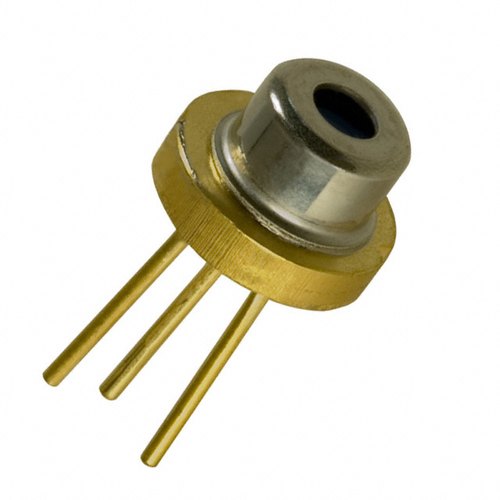
The wavelength of a laser diode refers to the wavelength of the laser beam it emits. Wavelength describes the characteristics of an electromagnetic wave, typically measured by the number of wave crests or troughs per unit length. A longer wavelength means a greater distance between peaks or troughs, while a shorter wavelength indicates a smaller distance between peaks or troughs.
Laser diodes can emit laser light at different wavelengths, with the specific wavelength determined by the material and device structure of the laser diode. Common laser diode wavelengths include red light (630-680 nm), green light (520-530 nm), and blue light (445-465 nm). The selection of a laser diode’s wavelength primarily depends on the application requirements.
Different application fields have varying demands for laser diode wavelengths. Below, we will detail the advantages and application areas of laser diode wavelengths.
Advantages of Long vs. Short Wavelengths
Long-Wavelength Laser Diodes: Strengths & Applications
Long-wavelength laser diodes exhibit low propagation loss in air, enabling greater penetration distances. This makes them highly valuable in fields such as communications, fiber optics, and lidar. For instance, infrared laser diodes with wavelengths between 700-1000 nm are suitable for fiber optic communications, allowing transmission over extended distances within optical fibers.
On the other hand, long-wavelength laser diodes also find extensive use in medical diagnostics, life sciences, and laser therapy. Near-infrared laser diodes with wavelengths around 800 nm, for instance, exhibit superior penetration capabilities in medical imaging and biological tissue imaging, making them suitable for detecting and treating skin lesions.
Short-Wavelength Laser Diodes: Strengths & Applications
Short-wavelength laser diodes excel in high-precision measurement and high-resolution imaging applications. Their higher optical energy and smaller spot size make them widely adopted in scenarios requiring superior spatial resolution.
For instance, blue and green laser diodes are extensively employed in laser printing, laser displays, lithography, and precision machining. Blue diodes typically operate within the 440-480 nm wavelength range, while green diodes function between 510-540 nm. These short-wavelength laser diodes deliver finer image detail and higher resolution.
Key Factor: Excited Material Properties
Additionally, the selection of laser diode wavelength depends on the properties of the excited material. For instance, specific materials exhibit distinct fluorescence characteristics at different wavelengths. If the goal is to achieve specific objectives by exciting the fluorescence of a material, a laser diode with a specific wavelength must be chosen. This is particularly important in applications such as color display, laser illumination, and biological labeling.
Fiber Requirements for Visible Light Laser Diodes
Laser diodes in the visible light spectrum—red, green, and blue—differ from conventional communication wavelengths (850/1310/1550 nm) in that they are more “picky” about fiber requirements. Below is a breakdown of optimal fiber types for each visible wavelength:
Red Light (630–680 nm)
- Plastic optical fiber (POF) is optimal
- Multimode quartz fiber also performs well
- Short distances: Any type acceptable; long distances: POF preferred
Green Light (520–530 nm)
- Multimode quartz fiber (50/125 or 62.5/125)
- For low loss, use specialized visible-light fiber
Blue Light (445–465 nm)
- Multimode quartz fiber (larger core diameter preferred)
- High power requires high damage threshold fiber
- Specialized low-loss fiber recommended for long distances