
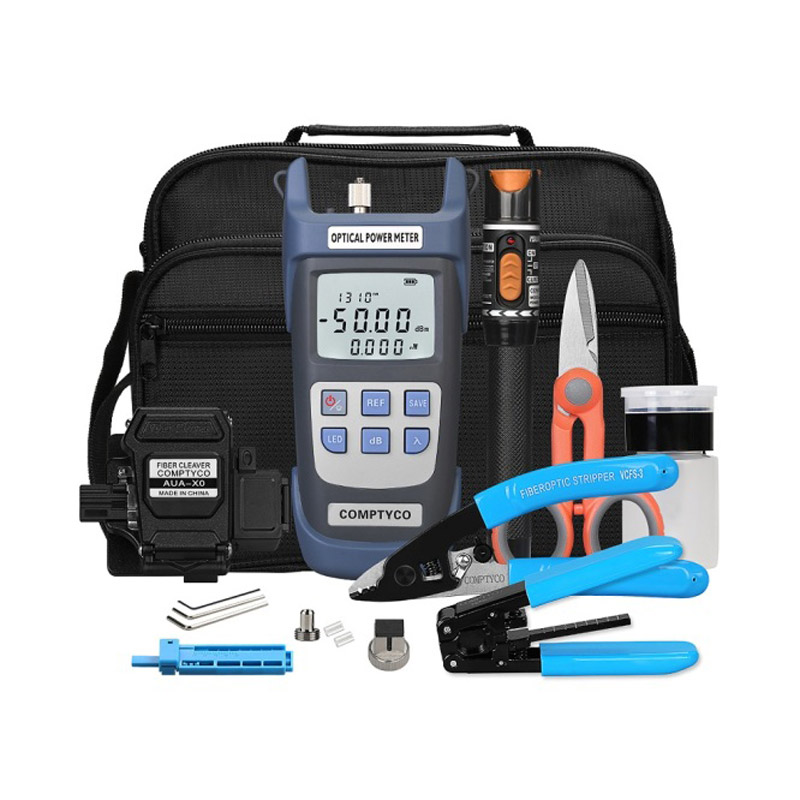
Cold splicing and fusion splicing are the two most common connection methods in fiber optic communications. Each has its own advantages and disadvantages, and selecting the appropriate method requires consideration of multiple factors, including connection quality, connection speed, cost, and maintenance.
I. Cold Splicing: Principle, Types, and Suitability
Cold splicing refers to a fiber connection method that avoids heating or melting the fiber cores. Instead, it relies on mechanical alignment and external force to join two optical fibers precisely. This technique is widely used in scenarios where quick installation is prioritized, and it mainly includes two common forms: mechanical fiber connectors and fiber optic pigtails.
1. Mechanical Fiber Optic Connectors
Mechanical fiber optic connectors establish connections through purely mechanical means, typically consisting of a fiber connector and a mating adapter. The installation process is straightforward: insert the stripped fiber into the connector, then fit the connector into the adapter to form a stable joint.
Advantages: Its greatest merit lies in simplicity—no special equipment or professional technical skills are required, making it ideal for on-site installation and emergency maintenance. This convenience reduces downtime in temporary or low-demand scenarios.
Limitations: The non-hermetic connection is highly vulnerable to environmental factors like dust, moisture, and temperature fluctuations, which can deteriorate connection stability. Moreover, the small contact area between fibers results in higher insertion loss, rendering it unsuitable for laser applications that demand high-precision, low-loss transmission (e.g., high-power fiber lasers, medical laser systems).
2. Fiber Optic Pigtails
Fiber optic pigtails are pre-terminated fibers with connectors (such as LC, SC, or ST types) attached to both ends. Connections are completed by plugging the pigtail into the target fiber or equipment, and they are usually composed of high-quality fiber connectors and cables for enhanced reliability.
Advantages: Compared to mechanical connectors, pigtails offer better connection quality and lower transmission loss, making them suitable for high-speed and long-distance transmission. They can withstand moderate environmental stress, which allows for use in laboratory setups and some industrial environments.
Limitations: Installation and maintenance are relatively complex, requiring specialized tools and professional expertise. Similar to mechanical connectors, their alignment accuracy is still insufficient for high-power or specialized laser fibers, limiting their application scope in advanced laser systems.
II. Fusion Splicing: The Preferred Choice for Laser Applications
Fusion splicing is a high-precision connection method that fuses two optical fibers into a seamless joint. Using a fiber optic fusion splicer, the process involves stripping the fiber cladding, aligning the cores with extreme precision, and then melting the fiber ends via controlled heating (typically from an electric arc) while applying slight pressure to form a single, continuous fiber.
Core Advantages for Laser Systems
- Ultra-low loss & superior quality: Fusion splicing achieves near-zero insertion loss by creating a seamless core connection, ensuring maximum signal/laser power transmission—critical for high-power laser applications where energy waste or signal degradation is unacceptable.
- Environmental stability: The hermetic joint is highly resistant to dust, moisture, and temperature changes, providing long-term stability in harsh industrial or medical environments (e.g., laser welding/cutting equipment, surgical laser transmission).
- High bandwidth & transmission speed: The seamless connection supports ultra-high bandwidth and transmission rates, making it compatible with advanced laser systems that require fast, stable signal propagation.
- Precise alignment for specialized fibers: For high-power or specialty fibers (e.g., pump fibers, double-clad fibers, rare-earth-doped fibers), fusion splicing ensures accurate core alignment—something cold splicing cannot guarantee. Poor alignment in cold splicing can lead to excessive loss, fiber damage, or even system failure in laser applications.
Typical Laser Applications of Fusion Splicing
Due to its unparalleled performance, fusion splicing is the go-to method for critical laser applications, including:
- Pump beam combining in fiber lasers, where precise alignment ensures efficient power aggregation.
- Medical laser transmission fibers, where low loss and sterility (via hermetic joints) are essential for surgical precision.
- Internal connections in industrial laser welding/cutting equipment, where stability and durability withstand high-vibration, high-temperature environments.
Conclusion
While cold splicing offers convenience and cost-effectiveness for low-demand, temporary connections, fusion splicing’s precision, low loss, and environmental stability make it indispensable in laser technology. For high-power, specialized, or mission-critical laser systems, fusion splicing is the only method that can meet the stringent requirements of reliable, efficient fiber connection.