
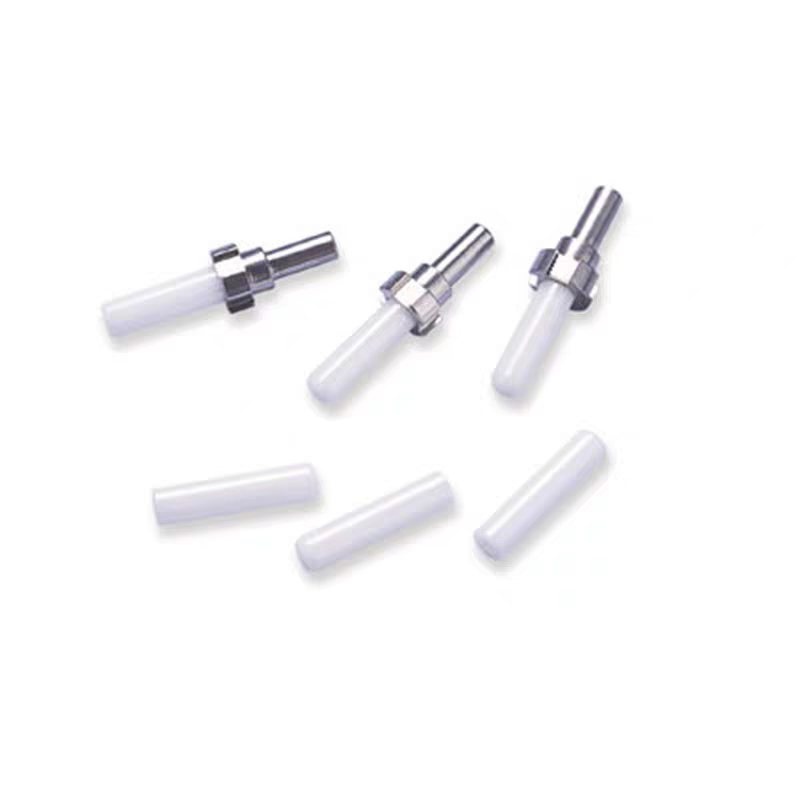
As the core component of any fiber optic connector, this small but critical part is responsible for precisely securing and protecting the fiber endface, ensuring low-loss transmission of optical signals. Whether you’re working on a telecom project, setting up home fiber, or exploring industrial applications, understanding the different types of fiber optic ferrules is key to choosing the right solution.
Fiber optic ferrules can be categorized based on several key factors: material, structure, and application scenarios. Let’s break down each category in detail.
1. Fiber Optic Ferrules Classified by Material
The material of a ferrule directly impacts its performance, durability, precision, and cost. Here are the most common material-based types:
Ceramic Ferrules (ZrO₂)
By far the most widely used type, ceramic ferrules are made from zirconia (ZrO₂) – a material that boasts impressive properties: high hardness, excellent wear resistance, high-temperature tolerance, and strong chemical stability. What sets them apart is their exceptional precision: the inner bore diameter tolerance can be controlled within ±0.5μm, making them suitable for both single-mode and multi-mode fibers.
Applications: Ceramic ferrules are the go-to choice for mainstream fiber optic connectors, including SC, LC, FC, and ST models. For example, LC ferrules have a 1.25mm outer diameter, while SC ferrules measure 2.5mm.
Metal Ferrules
Typically crafted from stainless steel or copper alloys, metal ferrules excel in mechanical strength. However, they fall short of ceramic ferrules in terms of precision and corrosion resistance. Their rugged nature makes them ideal for specialized environments.
Applications: High-temperature settings, high-impact scenarios, and military equipment where durability takes precedence over ultra-high precision.
Plastic Ferrules
Plastic ferrules are the most cost-effective option, but they trade off precision and durability for affordability. They’re not designed for high-performance or long-term use, but they work well in low-demand scenarios.
Applications: Consumer electronics, home fiber optic equipment (such as certain fiber-to-the-home terminals), and short-distance, low-speed data transmission setups.
Glass Ferrules
Glass ferrules are a niche option used exclusively for specialized optical components. They’re not common in standard connectors but play a role in specific optical systems.
Applications: Specialized optical components like capillary ferrules (e.g., in fiber optic collimators).
2. Fiber Optic Ferrules Classified by Structure
When it comes to structure, ferrules are primarily divided into two categories: contact and non-contact. The non-contact type, defined by its end-face design (PC/UPC/APC), is the most relevant for standard communications – let’s focus on those:
Non-Contact Ferrules (PC/UPC/APC End-faces)
- PC (Physical Contact): Features a slightly convex end-face, which helps minimize the air gap between mating ferrules, reducing signal loss.
- UPC (Ultra Physical Contact): Boasts a higher curvature radius than PC ferrules, resulting in superior performance with reflection loss < -50dB.
- APC (Angled Physical Contact): Has an 8° beveled polish, which significantly reduces reflection. It offers the best performance among the three, with reflection loss < -60dB.
Key Performance Metrics to Consider
No matter the type, certain performance metrics determine how well a ferrule will perform. Here are the most critical ones:
- Bore Diameter: For single-mode fibers, the standard bore diameter is 125μm (matching the fiber cladding) with a +1μm tolerance.
- Concentricity: This refers to the deviation between the fiber core and the ferrule’s outer diameter. Poor concentricity directly increases insertion loss.
- End-Face Geometry: Factors like curvature radius (for PC/UPC) and apex offset (for APC) are crucial. APC ferrules, in particular, require strict angular control to maintain performance.
- Harsh Environment Suitability: For extreme conditions, metal or industrial-grade ceramic ferrules are the best choice.
Top Ceramic Ferrule Models for Standard Communications
As we mentioned earlier, ceramic ferrules (with UPC/APC end-faces) dominate standard communications. Here’s a closer look at one of the most common models:
FC Ceramic Ferrule
- Material: Typically zirconia (zirconium oxide)
- Outer Diameter: 2.5 mm
- Fiber Bore Diameter: 125 μm (optimized for single-mode fibers)
- Connection Design: Threaded (ensures secure, stable mating)
- Common Applications: Telecommunications networks, premises cabling systems

SC Ceramic Ferrule:
- Often made of zirconia or alumina
- Ferrule outer diameter: 2.5 mm
- Fiber bore diameter: 125 μm (for single-mode fibers)
- Push-pull design for connection
- Widely used in local area networks (LANs) and data centers
LC Ceramic Ferrule:
- Typically made of zirconia
- Ferrule outer diameter: 1.25 mm (smaller than FC and SC)
- Fiber bore diameter: 125 μm (for single-mode fibers)
- Compact push-pull design
- Commonly used in high-density applications, such as data centers and premises cabling
Final Thoughts
Choosing the right fiber optic ferrule boils down to matching the type to your application’s needs. For standard, high-performance communications, ceramic ferrules (UPC/APC) are the gold standard. For harsh or military environments, metal ferrules are the way to go. And for budget-friendly, low-demand setups, plastic ferrules work perfectly.
Remember: No matter which ferrule you choose, it must be paired with a matching fiber connector type. This ensures end-face cleanliness and mating accuracy, ultimately minimizing insertion loss and return loss – the two biggest enemies of reliable fiber optic transmission.