
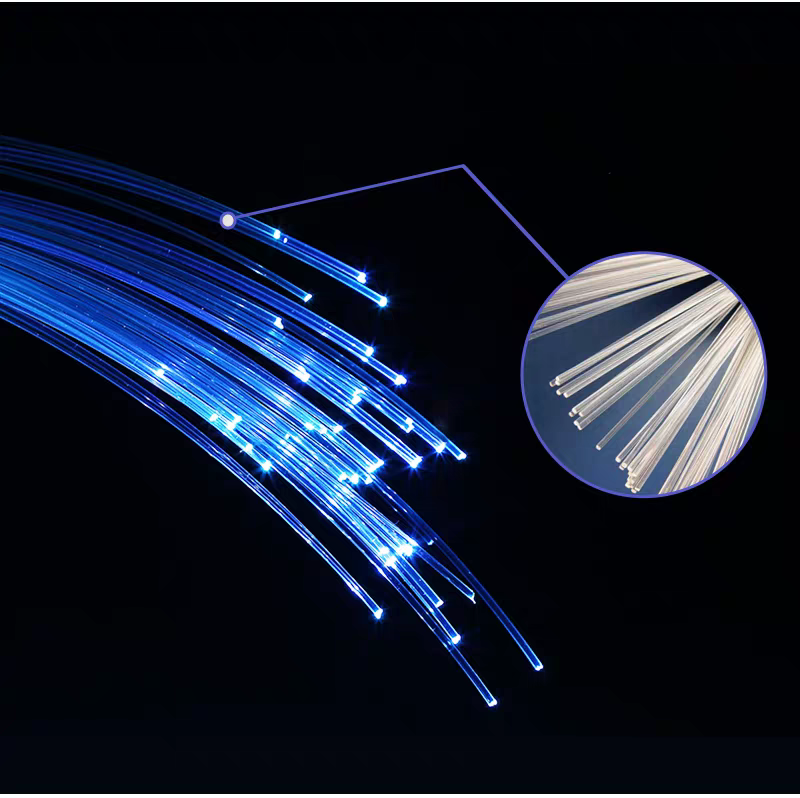
Plastic Optical Fibers (POF) have become a go-to choice for decorative lighting, industrial sensing, and even medical applications—thanks to their flexibility, safety, and versatility. But not all POFs are created equal. Today, we’re breaking down the two most common types: End-Glow POF (the “basic model”) and Side-Glow POF (the “linear light specialist”). By the end, you’ll know exactly which one fits your project.
End-Glow POF: The “Point Light” Specialist
End-glow POF is the closest to what most people picture when they hear “optical fiber.” Its defining feature? An exceptionally uniform cladding that keeps light contained. Here’s how it works:
Light travels forward through the fiber’s core via total internal reflection—meaning almost no light leaks from the sides. All the light energy is concentrated at the very tip of the fiber, turning it into a precise “point light” source.
Top Applications for End-Glow POF
Because it transports light from one point to another with zero waste, end-glow POF shines (pun intended) in these scenarios:
- Starry Ceilings: Its most iconic use! Embed hundreds or thousands of thin end-glow fibers into a ceiling, and their lit tips create a stunning, realistic starry sky effect—perfect for bedrooms, home theaters, or hotels.
- Museum Lighting: Artworks are sensitive to UV rays and heat. End-glow POF lets you place light sources (LEDs or metal halide lamps) far away, directing only “cool light” onto exhibits to protect fragile artifacts.
- Ground/Step Lights: Embed them along park paths or stair edges, and their tiny lit tips provide subtle, safe illumination—blending functionality with aesthetics.
- Medical/Industrial Sensing: Ideal for localized illumination or signal acquisition in hard-to-reach places, like inside the human body or high-temperature/high-pressure industrial environments.
Side-Glow POF: The “Linear Light” Expert
Side-glow POF takes a different approach: it’s designed to let light “leak” laterally (from the sides) during transmission. This is achieved by modifying the fiber’s materials (adding scattering particles) or physical structure (scratching the surface or disrupting the cladding).
Two common types of side-glow POF are often confused—MMA and PMMA—but they’re surprisingly different. Let’s break them down.
1. MMA Side-Glow Fiber (Solid Soft-Core)
MMA side-glow fiber is typically made by polymerizing monomers (like MMA) directly inside a Teflon (PTFE) tube. It’s all about flexibility and bold, soft light.
- Physical Properties: Solid, soft gel-like or soft plastic texture. Extremely resilient—can be bent at large angles without breaking.
- Light Emission Principle: Scattering particles in the core material diffuse light uniformly from the sides.
- Core Advantages: Extra-large diameter (3mm to 20mm+), UV-free, non-conductive, and waterproof—perfect for wet environments.
- Visual Effect: Soft lateral light that mimics neon tubes.
- Typical Applications: Pool perimeter lighting, interior accent lines, automotive ambient lighting (thanks to its larger diameter).
2. PMMA Full-Body Side-Emitting Fiber
PMMA side-glow fiber uses standard communication-grade or decorative-grade PMMA material, modified through physical processing to enable lateral light emission. It’s built for precision and longer transmission.
- Physical Properties: Hard material with thin diameters (0.25mm to 3.0mm). Bending thicker diameters too much can cause fracturing or white streaks.
- Lighting Principle: Light spills laterally thanks to surface coating disruption, indentations, or special fluorescent/scattering agents added during manufacturing.
- Core Advantages: Higher light transmission efficiency and lower attenuation (for well-processed products) compared to MMA. Perfect for precision applications.
- Typical Applications: Fiber-optic apparel, luminous carpets, light-guiding indicators for precision electronics.
How to Choose Between End-Glow & Side-Glow POF?
The choice comes down to your project’s needs—here’s a quick cheat sheet:
- Choose End-Glow POF if you need precise point light (e.g., starry ceilings, museum lighting, medical sensing).
- Choose MMA Side-Glow POF for thick, soft linear light (e.g., pool lighting, architectural outlines, automotive ambient light).
- Choose PMMA Side-Glow POF for ultra-fine linear light (e.g., fiber-optic clothing, luminous fabrics, precision indicators).
Pro Tip
Remember: POFs themselves don’t emit light—they’re just “light carriers.” To get the best effect, connect a high-power LED light engine to one or both ends of the fiber. This ensures bright, consistent light for your project.
Whether you’re designing a cozy starry ceiling, a sleek architectural accent, or a precision industrial sensor, understanding the difference between end-glow and side-glow POF will help you get the job done right. Have a specific project in mind? Drop a comment below—I’d love to help you pick the perfect fiber!