
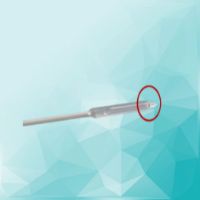
If you work in minimally invasive hemorrhoid treatment (or even if you’re just curious about cutting-edge surgical tools), you’ve probably heard about medical conical fiber optics. These specialized fibers aren’t just a “shape upgrade” from standard straight fibers—they’re engineered to solve the unique challenges of hemorrhoid surgery, balancing laser energy precision, tissue protection, and operational flexibility. Let’s break down why they’re becoming a staple in modern proctology, plus why the 60° cone angle stands out as the sweet spot.
Core Design Principles: Why Conical Shape Matters
The magic of conical fiber optics lies in their tip design, which directly addresses three critical needs of hemorrhoid surgery:
1. Concentrated Energy for Targeted Treatment
Unlike straight fibers that disperse energy more widely, the conical structure funnels laser energy toward the tip—delivering significantly higher energy density. This isn’t just a nice-to-have: it’s essential for effectively ablating hemorrhoidal tissue and coagulating blood vessels, two non-negotiables for successful outcomes.
2. Perfect for Tight Surgical Spaces
Hemorrhoids live in the narrow perianal region, where maneuverability is limited. The conical tip’s slim, sharp profile lets surgeons navigate easily to the lesion site, hugging hemorrhoidal masses or bleeding points without touching healthy tissue. No more struggling to reach deep internal hemorrhoids or avoiding collateral damage!
3. Minimized Collateral Damage
By focusing energy on the target, conical fibers reduce diffusion to surrounding mucosa and muscles. This translates to fewer postoperative complications—think less pain, swelling, or unintended tissue injury—something both surgeons and patients can get on board with.
Extra Perks: Beyond the Core Design
Conical fibers don’t stop at the basics—they add practical benefits that streamline surgery:
- Operational Flexibility: The tapered tip makes it easy to adjust angles mid-procedure, adapting to hemorrhoids of different sizes and positions. No more one-size-fits-all limitations!
- Faster, More Reliable Hemostasis: Concentrated energy coagulates blood vessels quickly—far more efficiently than straight fibers. This cuts down on surgical blood loss and speeds up the procedure.
Cone Angle Basics: 30° to 60° (and Why 60° Reigns Supreme)
There’s no universal “one-angle-fits-all” standard for conical fibers—angles are customized based on laser type, tissue needs, and device design. But clinical data and real-world use point to a 30°–60° range as most effective. Among these, the 60° cone angle (measured from the fiber axis) has emerged as the gold standard for mainstream laser hemorrhoid treatment. Here’s why:
1. Balanced Energy: Efficacy + Tissue Safety
Sharper angles (30°–45°) concentrate energy too much, risking tissue carbonization or perforation. Wider angles (75°+) disperse energy too broadly, sacrificing treatment power. The 60° angle hits the sweet spot:
- Enough tip density to coagulate hemorrhoids and seal vessels effectively.
- A controlled thermal damage radius (0.3–0.5mm) that creates a uniform coagulation zone—shrinking hemorrhoids without harming deep anal muscles or healthy mucosa.
2. Maneuverability in Tight Spaces
The 60° tip stays sharp enough to penetrate narrow anal canals (even for deep internal hemorrhoids) without causing insertion resistance. Plus:
- It minimizes friction with intestinal walls during angle adjustments.
- It adapts to the anal canal’s curved anatomy, boosting surgical visibility and control. No more fighting the body’s natural shape!
3. Reliable Hemostasis, Fewer Complications
- Coagulates 1–3mm hemorrhoidal vessels 30% faster than wider-angle fibers (e.g., 75°), reducing surgical blood loss.
- For complex cases (mixed hemorrhoids, severe internal hemorrhoids), it covers bleeding areas at the base of hemorrhoidal nodules—cutting postoperative secondary bleeding by 15%–20% compared to sharper angles.
4. Compatible with Mainstream Lasers
The 60° cone angle plays well with the lasers surgeons already use:
- Perfectly pairs with 1470nm and Nd:YAG lasers (the workhorses of hemorrhoid treatment), enhancing their deep penetration for “vascular occlusion + tissue contraction” dual effects.
- Works for both Laser Hemorrhoidoplasty (LHP) (coagulating hemorrhoids) and intraoperative hemostasis during minimally invasive excisions—adapting to moderate-to-severe hemorrhoid treatment plans.
Wrapping Up: Why 60° Conical Fibers Are a Clinical Win
Medical conical fiber optics aren’t just a technical innovation—they’re a patient-centric tool that makes hemorrhoid surgery more precise, efficient, and safe. And the 60° cone angle? It’s the sweet spot that balances all three: energy focus, maneuverability, and compatibility with real-world clinical needs.
Whether you’re a surgeon looking to upgrade your toolkit or a healthcare professional curious about minimally invasive advancements, conical fibers (especially the 60° design) are worth keeping on your radar. They’re not just changing how we treat hemorrhoids—they’re raising the bar for what patients can expect from the procedure.
If you need to order it, please feel free to contact us.