
In the world of high-speed optical communication, maintaining signal integrity over long distances is a constant challenge. Enter the Optical Fiber Amplifier (OFA)—the powerhouse of modern all-optical networks. Whether you are building a metropolitan backbone or a local FTTH (Fiber to the Home) setup, choosing the right amplifier is critical.
In this guide, we’ll break down the different types of amplifiers, their applications, and how to choose the right one for your infrastructure.
1. The Core Technology: How EDFAs Work
The most common type of OFA is the Erbium-Doped Fiber Amplifier (EDFA). These devices act as the “engine” of DWDM systems, amplifying signals without converting them back into electricity.
Key Functions by Position:
- OBA (Optical Booster Amplifier): Located at the transmitter end to boost power before the signal enters the fiber.
- OLA (Optical Line Amplifier): Placed at relay segments to compensate for fiber loss during long-haul transmission.
- OPA (Optical Pre-Amplifier): Situated at the receiver end to ensure the signal is strong enough for the detector.
Technical Snapshot:
- Gain Medium: Erbium-doped fiber.
- Pump Source: 980 nm or 1480 nm lasers.
- Capability: Supports unified amplification for C-band (40/48/80/96 wavelengths).
2. Choosing Your Form Factor: Modular vs. Rack-Mount
Not all amplifiers are built for the same environment. Understanding the hardware housing is just as important as the optical specs.
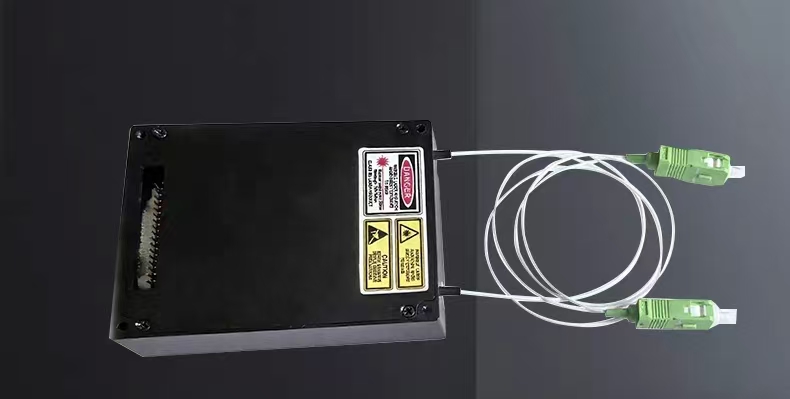
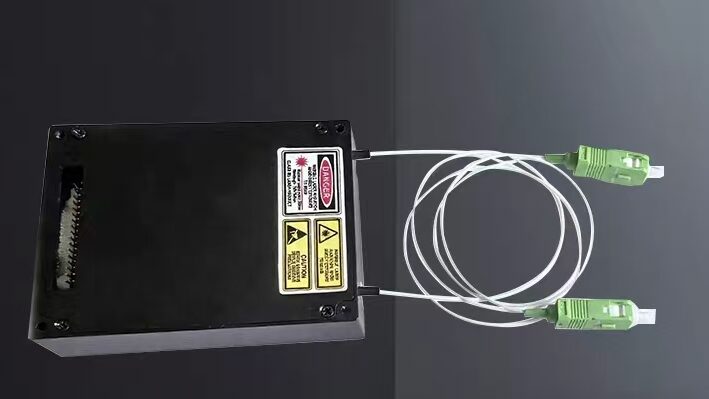
Compact Modular Amplifiers
These are agile, “plug-and-play” modules designed for integration and tight spaces.
- Best For: Small CATV distribution, FTTH in residential buildings, and laboratory prototyping.
- Typical Scenarios: Hallway optical nodes, surveillance equipment integration, and outdoor enclosures.
- Reliability: Since these often lack active cooling and reside in non-server room environments, the pump laser lifespan is typically 5–8 years.
Rack-Mounted Amplifiers (1RU)
These are telecom-grade machines built for high-density, mission-critical environments.
- Best For: Backbone networks, data center cores, and large-scale HFC (Hybrid Fiber-Coaxial) headends.
- Key Features: Redundant power supplies, active cooling, and SNMP/Web management interfaces.
- Reliability: Thanks to controlled environments, these boast an MTBF of >100,000 hours and a pump laser lifespan of 10–15 years.
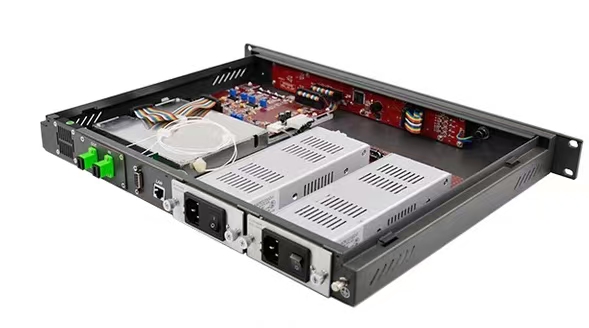
3. Featured Spotlight: The RACK 1RU TYPE
For those looking for a robust rack-mount solution, the RACK sets the standard for reliability and flexibility.
| Feature | Specification |
| Form Factor | 1RU (442 x 350 x 44 mm) |
| Control Mode | Automatic Gain Control (AGC) |
| Signal Support | C-band DWDM (up to 96 wavelengths) |
| Advanced Optics | Built-in EVOA for auto-power adjustment |
| Expandability | Supports Mid-stage Access (MSA) for DCM/OADM |
4. Selection Criteria: What Should You Look For?
Before purchasing, evaluate your needs based on these four pillars:
- Technical Specifications: Gain flatness, noise figure (NF), and saturated output power.
- Application Suitability: Is it for a climate-controlled data center or a dusty outdoor cabinet?
- O&M & Compatibility: Does it support SNMP for remote management? Is it compatible with your existing DWDM mux/demux?
- Cost & Supply Chain: Balance initial CapEx with the long-term OpEx of power consumption and maintenance.
Final Thoughts
The right optical amplifier doesn’t just make the signal louder; it makes your entire network more resilient. From small-scale surveillance nodes to massive metropolitan rings, understanding the nuances of EDFA placement and hardware durability is key to a successful deployment.
Need help sizing your network? [Contact oContactur engineering team toContactday] for a custom link budget analysis!