
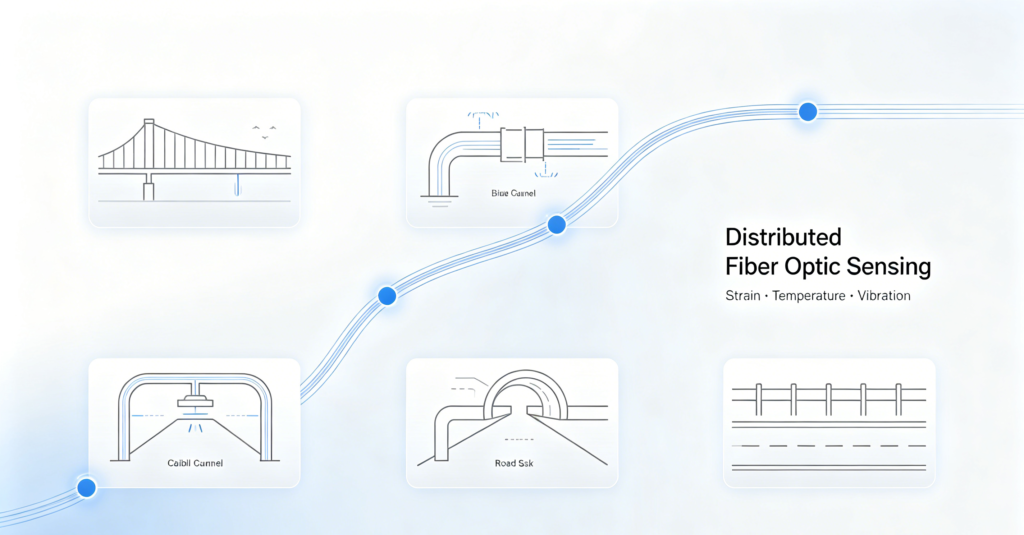
Critical infrastructure such as bridges, tunnels, pipelines and power assets requires 24/7 reliable monitoring. Fiber optic sensing forms a stable, full-coverage perception neural network for modern digital infrastructure.
Key Advantages
- EMI-free and intrinsically safe for harsh, hazardous environments
- Long-distance distributed sensing coverage up to 100km
- Ultra-high sensitivity to detect micro strain, temperature and vibration changes
- Superior durability and stable performance under extreme conditions
Four Core Sensing Technologies & Application Scenarios
- FBG (Fiber Bragg Grating): High-precision, fast-response point sensing for key structural areas. Application: Used on long-span bridges, airport runways and hydraulic dams to monitor micro deformation, structural fatigue and foundation settlement, enabling precise early warning of structural degradation.
- φ-OTDR: Full-line distributed vibration monitoring for intrusion and disturbance detection.Application: Suitable for long-distance energy pipelines and urban tunnels. It identifies external excavation, mechanical disturbance and geological vibration, filling the monitoring blind spots of traditional visual systems for linear underground infrastructure.
- ROTDR: High-resolution full-line distributed temperature monitoring. Application: Widely deployed in utility tunnels, cable galleries and heating pipelines. It pinpoints overheating and thermal leakage in real time, delivering effective fire prevention and safety assurance for enclosed infrastructure spaces.
- BOTDR/BOTDA: Ultra-long-distance synchronous strain and temperature sensing. Application: Optimized for extended linear infrastructure including cross-region pipelines and plateau roadways. It continuously captures long-range structural deformation and temperature variation to support long-term structural and geotechnical health evaluation.
Core Industry Value
- Enables real-time hidden risk early warning, transforming infrastructure management from passive repair to active prevention
- Adopts passive fiber design, cutting power supply and maintenance costs for large-scale monitoring systems
- Provides high-density, continuous sensing data to support digital twin modeling and intelligent infrastructure operation
Constrained by distance, environment and precision limits, traditional electronic sensors struggle to meet modern infrastructure monitoring demands. The hybrid fiber optic sensing solution integrates precise point monitoring and full-range distributed sensing, building a complete perceptual neural network and serving as a core foundational technology for smart digital infrastructure development.
#FiberOpticSensing #DigitalInfrastructure #StructuralHealthMonitoring #DistributedSensing #DigitalTwin #SmartEngineering