
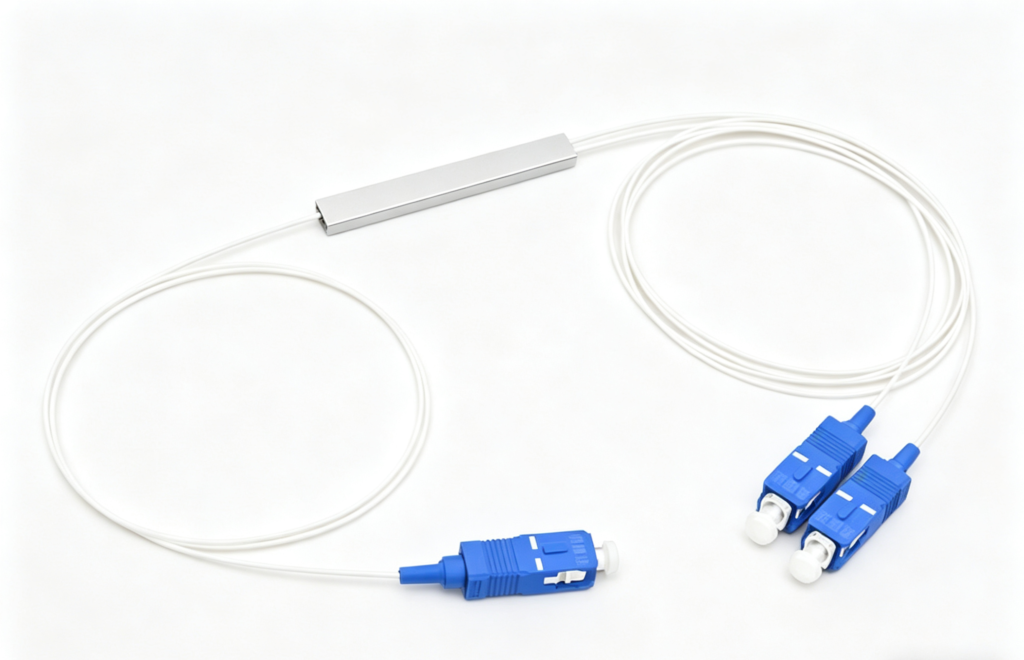
The short answer is a definitive yes. In fact, single-mode splitters are the backbone of modern Fiber-to-the-Home (FTTH) networks. In this post, we’ll dive into how they work, the different types available, and their real-world applications.
What is a Single-Mode Splitter?
An optical splitter (also known as a coupler) is a passive device that can either split a single optical signal into multiple paths or combine multiple signals into one. By using these devices, network architects can distribute a single signal to multiple receivers or sensors, significantly reducing the complexity and cost of fiber cabling.
Key Performance Metrics:
- Low Insertion Loss: Minimal signal strength is lost when passing through the device.
- High Return Loss: Excellent prevention of signal reflection back to the source.
- Precision: High reliability in signal distribution across various ports.
How Optical Splitters Work
The magic happens through a phenomenon known as Evanescent Wave Coupling.
When light travels through a single-mode fiber, the energy isn’t strictly confined to the core; a small portion of the “mode field” extends into the surrounding cladding. By bringing the cores of two fibers extremely close to one another—usually through specialized heating and stretching—the light from one fiber can “leak” into the other. This allows the signal to be redistributed across multiple paths.
The Two Main Types of Splitters
While there are many ways to classify splitters, the industry primarily focuses on two manufacturing technologies:
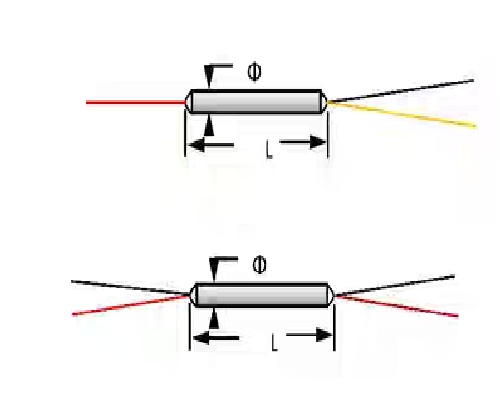
1. FBT (Fused Biconical Tap) Couplers
FBT is the “traditional” method. Multiple fibers are bundled, heated, and stretched (tapered) simultaneously.
- Best for: Small port counts (1×2, 2×2) and customized, unequal splitting ratios (e.g., 1/99 or 10/90).
- Versatility: Our single-mode FBT couplers support a full bandwidth of 1260–1620 nm, making them bidirectional and highly flexible.
2. PLC (Planar Lightwave Circuit) Splitters
PLC technology is based on semiconductor processes, using photolithography to etch waveguides onto a quartz substrate.
- Best for: High port counts (1×8, 1×32, 1×64) and equal-split applications.
- Advantage: Offers better stability and a more compact footprint for large-scale distribution.
Applications & Specifications
Single-mode splitters are versatile tools used across various high-tech industries:
- Fiber Optic Communications: Essential for PON (Passive Optical Networks).
- Cable TV (CATV): Distributing video signals to multiple households.
- Medical Imaging: Used in OCT (Optical Coherence Tomography) for high-precision scans.
- Fiber Sensing: Monitoring infrastructure or environmental changes.
Product Features at a Glance
| Feature | Detail |
| Reliability | High stability across diverse environments |
| Insertion Loss | Ultra-low for maximum signal integrity |
| Coupling Ratios | Arbitrary (1/99, 5/95, 20/80, 50/50, etc.) |
| Connector Types | FC/APC, SC/APC, SC/PC, LC/APC |
| Sleeve Options | Common 900 μm loose tube |
Things to Consider: Limitations
While splitters are incredibly useful, they aren’t without trade-offs. The primary concern is the Optical Power Budget.
In high-ratio splitting scenarios (like a 1:64 split), the signal is divided so many times that the “insertion loss” becomes significant. To maintain system performance, you may need to implement high-sensitivity receivers or optical amplifiers to ensure the signal remains clear at its destination.
Conclusion
Whether you are building a community network or a sensitive fiber sensor, single-mode splitters are essential components. By choosing between FBT and PLC technologies based on your specific ratio and port requirements, you can build a system that is both scalable and highly reliable.