
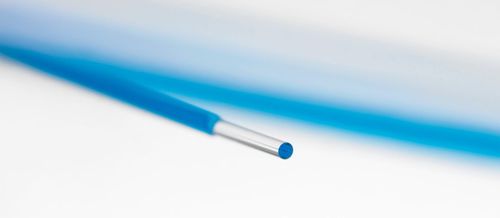
Optical fibers are the backbone of modern laser transmission. However, even though the quartz material in a fiber core is incredibly heat-resistant, high-power lasers are notorious for “burning” the fiber end-face.
This isn’t just a matter of the fiber getting “too hot.” It is a complex interaction of physics where tiny variables lead to catastrophic failure. Here are the five critical reasons why high-power lasers turn fiber ends into charcoal.
1. The “Magnifying Glass” Effect: Extreme Power Density
The core issue is that laser energy is compressed into an impossibly small area. As laser power rises, the power density increases exponentially, not just linearly.
- The Math of Destruction: A common single-mode fiber has a mode field diameter of only 10 μm. This results in an area of roughly 80 μm²—about 1/100th the thickness of a human hair.
- The Reality Check: * A 1W laser creates a density of 12.5 MW/cm².
- A 10W laser surges to 125 MW/cm².
Insight: Imagine concentrating 10W of power into the tip of a pin. Even heat-resistant quartz cannot dissipate this localized energy fast enough, leading to instant thermal structural failure.
2. Contamination: The Deadly Trigger
In high-power environments, microscopic debris becomes a “fuse.” Contaminants absorb energy much faster than the quartz itself, acting as the primary trigger for a burn.
- Invisible Dust: Experiments show that a dust particle just 1 μm in diameter (invisible to the naked eye) can have an absorption rate 100 times higher than quartz. Under a 5W laser, these particles can hit 1000°C in just 10 nanoseconds, igniting the surrounding quartz.
- The Fingerprint Threat: Oils and sweat from a single touch can cause rapid carbonization at just 3W, dropping coupling efficiency by over 30% and leaving permanent black scars.
3. Reflected Light & Localized “Hotspots”
The interface where the quartz meets the air creates a reflection. This reflected light can interfere with the incoming beam, creating “hotspots” where the energy is much higher than the average.
- Geometry Matters: If a fiber end-face has microscopic indentations from a poor cut, reflected light can focus into these pits.
- Case Study: In one industrial system, microscopic pits created hotspots 5 times higher than the incident light. A fiber rated for 8W failed at just 6W due to “spalling” (surface chipping).
4. The “Positive Feedback” Loop of Destruction
Fiber damage is rarely a one-time event; it is a rapidly accelerating chain reaction. Once a minor defect appears, it makes the fiber more “absorbent,” which leads to more heat, which leads to more damage.
- The Spiral: A laboratory test showed a pinhead-sized burn mark on a fiber. Because the burn mark absorbed energy 3 times faster than clean quartz, a 7W laser expanded that tiny dot into a 50μm-wide scar in only one minute.
- The Risk: If the system isn’t shut down immediately, the heat can travel backward, destroying the interior of the fiber and rendering the entire cable useless.
5. Misalignment: When the Laser “Misfires”
If the coupling between the laser source and the fiber is even slightly off, the high-power beam strikes areas that aren’t designed to handle it—like the cladding or the metal ferrule.
- The “Metal Melt” Scenario: In one laser cutting system, a misaligned lens caused 80% of a 10W beam to hit the metal sleeve instead of the core. The sleeve hit 600°C instantly, conducting that heat back to the fiber and causing the quartz to crack.
Conclusion
The destruction of fiber end-faces is the result of “High Power Density + Localized Absorption.” While quartz is tough, it cannot survive the concentrated energy of a high-power laser when contamination, reflection, or poor coupling are present.
To protect your equipment, remember the three golden rules of high-power fiber optics:
- Maintain absolute cleanliness (use a fiber microscope).
- Optimize coupling precision to ensure the beam hits the core.
- Perform regular inspections to catch “feedback” damage before it propagates.